Tuesday, July 29, 2014
Amazon’s Objective: Lower E book Prices
In the ongoing battle of perception between Amazon and Hachette, we ve had to speculate on the substance of the conflict. An intriguing post in the Kindle Forums by the Amazon Book Team makes a bold statement to publishing and Indie authors; lower e book prices are on the table.
http://feedproxy.google.com/~r/AmyEyrie/~3/S9g5mqoHUZA/

Wednesday, July 9, 2014
Barbarians at the Gate: Indies vs Big Publishing
The Fall of Rome is still debated. How could such an empire fall? Various theories are floated; taxes were too high, barbarians joined the army, borders became too porous, corruption and incompetence were rampant. But I would argue that these were mitigating factors. Empires always fall for the same reason. They stop adapting. Adaptive Capacity [ ]
http://feedproxy.google.com/~r/AmyEyrie/~3/LEwzQKK6mvA/
Saturday, February 1, 2014
From the Indie Side: A New Anthology
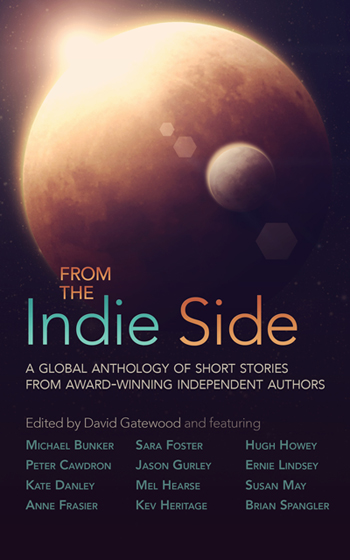
With some of the most talented new voices on the Indie scene, this anthology has the raw, electric energy of an underground movement. The stories span a multitude of genres; science fiction, fantasy, dystopian and paranormal. Many of the stories have a dark slant, many take place in dying or post apocalyptic worlds.
There’s excitement here. Meet the new paradigm; hard working craftspeople honing their writing and taking on the jobs traditionally left to publishers. Some of the stories in this collection are more polished than others, but all are well written, inventive and at times, even captivating. These writers are passionate about story as evidenced by the short commentary each author provides. It’s clear that obstacles, the paradigm shift in publishing or even a zombie apocalypse couldn’t stop these writers from their chosen rounds.
And I hope publishers and agents take notice, because allowing dedicated writers like these to slip through the net seems like a crime.
The editor, David Gatewood has a nose for talent and the anthology includes a range of material, nicely juxtaposed and often surprising. It’s a nice book, with clean prose and a modern bite.
Some of the writers stand out; Hugh Howey has a meticulous ear for dialogue and the ability to create an instant rapport with the plight of his characters. He’s a world builder who effortlessly draws you into a fully realized alternate reality. Michael Bunker has a gift for gritty realism and often surprises with his character’s quirky internal dialogue and his way of framing stories with a sense of encroaching dread. Anne Frasier creates a delicate, dreamlike, layering of experiences to weave a lyrical spell.
Sexism is notably absent and I was impressed by the fearlessness and range of the stories. Susan May takes a turn exploring the gruesome psychological effects of War while Kev Heritage takes on High Fantasy and tech magic. There’s a Twilight Zone-esque turn by Jason Gurley and Brian Spangler offers well-paced, unrelenting horror. Sara Foster offers a tricky surprise and Kate Danley, a malignant fairy tale. Ernie Lindsey imagines a society with a devastating ritual, Mel Hearse adds a dark twist and Peter Cawdron takes on a futuristic terrorism.
You will be catching some of these writers at an early stage in their journey. A few of them get caught up in the blow by blow action rather than the deeper currents of tension between the characters that drive a story forward. I would recommend a couple of these writers read Raymond Chandler’s thumbnail descriptions when establishing characters. But these are trivial points. What is important about the writers in From the Indie Side, is their sense of experimentation and absolute passion for writing. Highly recommended.
From the Indie Side: A New Anthology
From the Indie Side: A New Anthology
With some of the most talented new voices on the Indie scene, this anthology has the raw, electric energy of an underground movement. The stories span a multitude of genres; science fiction, fantasy, dystopian and paranormal. Many of the stories have a dark slant, many take place in dying or post apocalyptic worlds.
There’s excitement here. Meet the new paradigm; hard working craftspeople honing their writing and taking on the jobs traditionally left to publishers. Some of the stories in this collection are more polished than others, but all are well written, inventive and at times, even captivating. These writers are passionate about story as evidenced by the short commentary each author provides. It’s clear that obstacles, the paradigm shift in publishing or even a zombie apocalypse couldn’t stop these writers from their chosen rounds.
And I hope publishers and agents take notice, because allowing dedicated writers like these to slip through the net seems like a crime.
The editor, David Gatewood has a nose for talent and the anthology includes a range of material, nicely juxtaposed and often surprising. It’s a nice book, with clean prose and a modern bite.
Some of the writers stand out; Hugh Howey has a meticulous ear for dialogue and the ability to create an instant rapport with the plight of his characters. He’s a world builder who effortlessly draws you into a fully realized alternate reality. Michael Bunker has a gift for gritty realism and often surprises with his character’s quirky internal dialogue and his way of framing stories with a sense of encroaching dread. Anne Frasier creates a delicate, dreamlike, layering of experiences to weave a lyrical spell.
Sexism is notably absent and I was impressed by the fearlessness and range of the stories. Susan May takes a turn exploring the gruesome psychological effects of War while Kev Heritage takes on High Fantasy and tech magic. There’s a Twilight Zone-esque turn by Jason Gurley and Brian Spangler offers well-paced, unrelenting horror. Sara Foster offers a tricky surprise and Kate Danley, a malignant fairy tale. Ernie Lindsey imagines a society with a devastating ritual, Mel Hearse adds a dark twist and Peter Cawdron takes on a futuristic terrorism.
You will be catching some of these writers at an early stage in their journey. A few of them get caught up in the blow by blow action rather than the deeper currents of tension between the characters that drive a story forward. I would recommend a couple of these writers read Raymond Chandler’s thumbnail descriptions when establishing characters. But these are trivial points. What is important about the writers in From the Indie Side, is their sense of experimentation and absolute passion for writing. Highly recommended.
From the Indie Side: A New Anthology
Wednesday, January 8, 2014
Steampunk Carousels & Infernal Machines
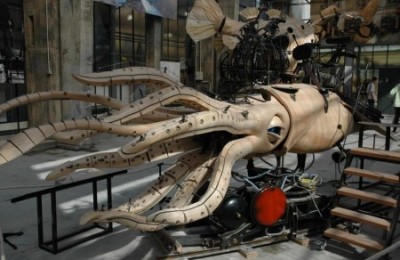
Science Fiction books of the of the Victorian age and the Belle Epoch echo certain themes.
After all, this was the age of Edison and Tesla, of mechanized war. It was an emerging era of shocking scientific theories such as evolution and flight. 19th century science fiction novels chart the course of these shocks with themes of science run amok and strange encounters with monstrosities. Steampunk imagery is generated from works of the fantastic such as Frankenstein, 20,000 Leagues Under the Sea, War of the Worlds and The Time Machine.
So, when I first saw The Project of Machines de l’île in Nantes, I felt for a moment that sense of wonder at that strange convergence of science and fantasy, machine and dream. All the beautiful and terrible possibilities of the future exist in these odd mechanisms.
The machines are built in the warehouses of the former shipyards of Nantes, France by François Delarozière and Pierre Orefice who were also inspired by Leonardo Da Vinci’s infernal machines.
And every so often they come alive.
Setting up The Sea Life Carousel
Riding the Sea Life Carousel
The Christmas Carousels of Brussels are also made by the artisans of Nantes
The Royal Elephant
The Heron Tree
The Hound and the Girl
The Spider
Steampunk Carousels & Infernal Machines
Steampunk Carousels & Infernal Machines
Science Fiction books of the of the Victorian age and the Belle Epoch echo certain themes.
After all, this was the age of Edison and Tesla, of mechanized war. It was an emerging era of shocking scientific theories such as evolution and flight. 19th century science fiction novels chart the course of these shocks with themes of science run amok and strange encounters with monstrosities. Steampunk imagery is generated from works of the fantastic such as Frankenstein, 20,000 Leagues Under the Sea, War of the Worlds and The Time Machine.
So, when I first saw The Project of Machines de l’île in Nantes, I felt for a moment that sense of wonder at that strange convergence of science and fantasy, machine and dream. All the beautiful and terrible possibilities of the future exist in these odd mechanisms.
The machines are built in the warehouses of the former shipyards of Nantes, France by François Delarozière and Pierre Orefice who were also inspired by Leonardo Da Vinci’s infernal machines.
And every so often they come alive.
Setting up The Sea Life Carousel
Riding the Sea Life Carousel
The Christmas Carousels of Brussels are also made by the artisans of Nantes
The Royal Elephant
The Heron Tree
The Hound and the Girl
The Spider
Steampunk Carousels & Infernal Machines
Monday, December 9, 2013
Scientist Grace Hopper explains Nanoseconds
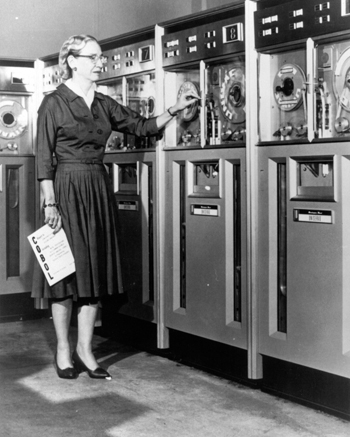
Google just honored Grace Hopper with a doodle and once you see her in action, you’ll know why.
Grace Hopper was an accomplished naval officer/computer scientist with a wry sense of humor and a down to earth style of communicating.
One of the first programmers on the Mark I Computer (IBM’s Automatic Sequence Controlled Calculator or ASCC), Grace Hopper once described the Mark I as having ” 72 words of storage and could perform three additions a second.”
In comparison, the cell phone in your pocket has more computing power than NASA’s first moon launch, so if you are using your phone to send lol cats…. think about it.
It’s not the power, it’s what you do with it.
The early behemoths Hopper worked on were as large as 51 feet long and 8ft high. She also worked on Harvard’s Mark II and III computers as well as the UNIVAC I computer.
Affectionately known as “Grandma Cobol,” because she lead the team that invented COBOL (Common Business-Oriented Language). She was one of the first computer scientists to campaign for “coding” as a computer language rather than strings of numbers. In many ways, that tendency defines Hopper. She had a no nonsense approach to computers that was eminently practical, always taking into account human nature and trying to find ways to make abstract concepts clear to the layman as well as the aspiring computer programmer.
One of the most famous Grandma Cobol stories was about the day her enormous computer was acting up. She traced the problem to a dead moth inside a sensitive area and was forced to debug the computer. The idea stuck and now we have computer bugs.
Here is Grace “Grandma Cobol” Hopper explaining the the nanosecond.
Scientist Grace Hopper explains Nanoseconds
Scientist Grace Hopper explains Nanoseconds
Google just honored Grace Hopper with a doodle and once you see her in action, you’ll know why.
Grace Hopper was an accomplished naval officer/computer scientist with a wry sense of humor and a down to earth style of communicating.
One of the first programmers on the Mark I Computer (IBM’s Automatic Sequence Controlled Calculator or ASCC), Grace Hopper once described the Mark I as having ” 72 words of storage and could perform three additions a second.”
In comparison, the cell phone in your pocket has more computing power than NASA’s first moon launch, so if you are using your phone to send lol cats…. think about it.
It’s not the power, it’s what you do with it.
The early behemoths Hopper worked on were as large as 51 feet long and 8ft high. She also worked on Harvard’s Mark II and III computers as well as the UNIVAC I computer.
Affectionately known as “Grandma Cobol,” because she lead the team that invented COBOL (Common Business-Oriented Language). She was one of the first computer scientists to campaign for “coding” as a computer language rather than strings of numbers. In many ways, that tendency defines Hopper. She had a no nonsense approach to computers that was eminently practical, always taking into account human nature and trying to find ways to make abstract concepts clear to the layman as well as the aspiring computer programmer.
One of the most famous Grandma Cobol stories was about the day her enormous computer was acting up. She traced the problem to a dead moth inside a sensitive area and was forced to debug the computer. The idea stuck and now we have computer bugs.
Here is Grace “Grandma Cobol” Hopper explaining the the nanosecond.
Scientist Grace Hopper explains Nanoseconds
Wednesday, December 4, 2013
Future Shock: Writing Sci Fi, Drones & Paranoia

Dystopia. The word hisses off the tongue with sibilant ease, a slow slide into the dark cellar of the collective psyche. The black regimes of our fears, the fascism, the rage, the oppression which mirrors our inner shades, often realized in nightmarish reality.
Conversely, Utopia sounds so hopeful, so inclusive, like a suspended note of a celestial choir. A future where technology is used compassionately to further creative pursuits, knowledge and collective awareness.
What’s it going to be?
One of the great tasks of Science Fiction is to explore humanity in the context of earth shattering change. In the case of Ray Bradbury’s Farenheit 451 with its mechanical hound or George Orwell’s 1984, the startling portrait of the darker probabilities of the future, shaped the minds of a generation. The word “Big Brother” is now part of our lexicon of ideas.
On the Utopian side, Gene Roddenberry’s Star Trek inspired cell phones, interactive computers and has scientists noodling over the possibility of matter transfer and warp drive.
Because I’m writing a dystopian novel, I research gadgets and technological trends and lately I’ve been struck by the accelerated pace of technology. Our society is on the verge of a sea change. This has happened before, when planes and tanks and telephones were invented and changed how we communicated, fought wars, lived and died.
Again, we find ourselves living in times of massive technological upheaval. The changes are happening all around us, every second of every day. We’ve already experienced the powerful transformation of our lives due to the internet, but in labs around the world strange inventions are preparing to shift our collective experience of reality in dramatic ways.
Here in Los Angeles, the DMV is working out regulations for driverless cars. Amazon is considering drone delivery technology, so is UPS who already has 3D printers in some locations. Anyone who feels like scoffing at the reality of these ideas, let me draw your attention back to the first days of the Internet when people said it would never work.
The new military drones coming down the assembly line will make the old ones look primitive. They will reach speeds of 460 mph with vertical take off and landing capability. They will be armed with hellfire missiles.

In labs around the world, scientists are making concepts once considered fringe science, into reality; mind reading machines, invisibility cloaks, laser weapons, microwave, acoustic and electromagnetic weapons, cloning extinct animals, crowd tasers, robots that can run you down or defuse bombs, insect droids, artificial DNA, artificial organisms built with a kill switch, 3D organ printers, anti-matter bombs, bio weapons and various ways to bio-enhance the human body including brain implants.
Our wired world has also introduced Orwellian levels of pure paranoia, since it is technically possible to spy on anyone or track them through their televisions, cellphones and computers.
From the Sci Fi writer’s point of view, the interesting part of the equation is always the human aspect. How will people react to technology? How will they enhance it or abuse it? Will they create dreams or nightmares?The United States Constitution did not predict the effect of phones, television, airplanes and atomic bombs, so a lot of that power over foreign affairs fell into the hands of one man, the president.
How will society react to mind reading and artificial organisms? Will we have a Star Trek style Utopia or a 1984 Dystopia? Sadly, the military industrial complex is pretty predicable. The amount of times my research has led me to a DARPA project is chilling. We also have the spooky revelations of Edward Snowden and Julian Assange as we watch the blow by blow information wars and disinformation campaigns play out.
After Jeff Bezos revealed his Amazon Air drone program on 60 minutes, UPS also admitted to having a drone program in the works. Within 24 hours a backlash of paranoid consumerism was unleashed. Naysayers waved regulation books and postulated the nefarious intentions of corporations, who now have the human right of free speech.
A paranoid reaction.
Which is good.
Because paranoia in this case is healthy. It’s the healthy side of fear. And probably the one thing that will save us. Because for every noble and beneficial act, there is a second possibility, that technology will serve the more hideous, destructive aspects of human nature.
As the ancient Greeks knew, Pandora can let every crazy ass demon out of that box, but inside there’s still hope. After all, the minute we had an internet, people used it to tell jokes and send stupid cat pictures.
Funny or Die’s take on the Amazon Drone issue:
Future Shock: Writing Sci Fi, Drones & Paranoia
Future Shock: Writing Sci Fi, Drones & Paranoia
Dystopia. The word hisses off the tongue with sibilant ease, a slow slide into the dark cellar of the collective psyche. The black regimes of our fears, the fascism, the rage, the oppression which mirrors our darkness, often realized in nightmarish reality.
Conversely, Utopia sounds so hopeful, so inclusive, like a suspended note of a celestial choir. A future where technology is used compassionately to further creativity, knowledge and collective awareness.
What’s it going to be?
One of the great tasks of Science Fiction is to explore humanity in the context of earth shattering change. In the case of Ray Bradbury’s Farenheit 451 with its mechanical hound or George Orwell’s 1984, the startling portrait of the darker probabilities of the future, shaped the minds of a generation. The word “Big Brother” is now part of our lexicon of ideas.
On the Utopian side, Gene Roddenberry’s Star Trek inspired cell phones, interactive computers and has scientists noodling over the possibility of matter transfer and warp drive.
Because I’m writing a dystopian novel, I research gadgets and technological trends and lately I’ve been struck by the accelerated pace of technology. Our society is on the verge of a sea change. This has happened before, when planes and tanks and telephones were invented and changed how we communicated, fought wars, lived and died.
Again, we find ourselves living in times of massive technological upheaval. The changes are happening all around us, every second of every day. We’ve already experienced the powerful transformation of our lives due to the internet, but in labs around the world strange inventions are preparing to shift our collective experience of reality in dramatic ways.
Here in Los Angeles, the DMV is working out regulations for driverless cars. Amazon is considering drone delivery technology, so is UPS who already has 3D printers in some locations. Anyone who feels like scoffing at the reality of these ideas, let me draw your attention back to the first days of the Internet when people said it would never work.
The new military drones coming down the assembly line will make the old ones look primitive. They will reach speeds of 460 mph with vertical take off and landing capability. They will be armed with hellfire missiles.
In labs around the world, scientists are making concepts once considered fringe science, into reality; mind reading machines, invisibility cloaks, laser weapons, microwave, acoustic and electromagnetic weapons, cloning extinct animals, crowd tasers, robots that can run you down or defuse bombs, insect droids, artificial DNA, artificial organisms built with a kill switch, 3D organ printers, anti-matter bombs, bio weapons and various ways to bio-enhance the human body including brain implants.
Our wired world has also introduced Orwellian levels of pure paranoia, since it is technically possible to spy on anyone or track them through their televisions, cellphones and computers.
From the Sci Fi writer’s point of view, the interesting part of the equation is always the human aspect. How will people react to technology? How will they enhance it or abuse it? Will they create dreams or nightmares?The United States Constitution did not predict the effect of phones, television, airplanes and atomic bombs, so a lot of that power over foreign affairs fell into the hands of one man, the president.
How will society react to mind reading and artificial organisms? Will we have a Star Trek style Utopia or a 1984 Dystopia? Sadly, the military industrial complex is pretty predicable. The amount of times my research has led me to a DARPA project is chilling. We also have the spooky revelations of Edward Snowden and Julian Assange as we watch the blow by blow information wars and disinformation campaigns play out.
After Jeff Bezos revealed his Amazon Air drone program on 60 minutes, UPS also admitted to having a drone program in the works. Within 24 hours a backlash of paranoid consumerism was unleashed. Naysayers waved regulation books and postulated the nefarious intentions of corporations, who now have the human right of free speech.
A paranoid reaction.
Which is good.
Because paranoia in this case is healthy. It’s the healthy side of fear. And probably the one thing that will save us. Because for every noble and beneficial act, there is a second possibility, that technology will serve the more hideous, destructive aspects of human nature.
As the ancient Greeks knew, Pandora can let every crazy ass demon out of that box, but inside there’s still hope. After all, the minute we had an internet, people used it to tell jokes and send stupid cat pictures.
Funny or Die’s take on the Amazon Drone issue:
Future Shock: Writing Sci Fi, Drones & Paranoia
Monday, December 2, 2013
Amazon Prime Air: Will Drones Deliver?
Remember The Jetsons? The cartoon about the future where the Jetson family had a plethora of wacky, futuristic gadgets to make life easier? Well it looks like CEO of Amazon Jeff Bezos took that show seriously.
Just when you’re getting used to an irobot vacuum scooting around the floor, Amazon just revealed the next level of droid services.
First Amazon created automated warehouses and now flying drones will deliver packages in under 30 minutes.
The drone delivery service is called Amazon Prime Air:
Amazon Prime Air: Will Drones Deliver?
Amazon Prime Air: Will Drones Deliver?
Remember The Jetsons? The cartoon about the future where the Jetson family had a plethora of wacky, futuristic gadgets to make life easier? Well it looks like CEO of Amazon Jeff Bezos took that show seriously.
Just when you’re getting used to an irobot vacuum scooting around the floor, Amazon just revealed the next level of droid services.
First Amazon created automated warehouses and now flying drones will deliver packages in under 30 minutes.
The drone delivery service is called Amazon Prime Air:
Amazon Prime Air: Will Drones Deliver?
Wednesday, October 23, 2013
Astronaut Chris Hadfield sings Space Oddity
With Gravity topping the box office, pushing special effects to the edge, I’m posting my favorite space clip, starring astronaut Chris Hadfield.
After attending the premiere, Hadfield tweeted about the film: “Good morning! Gravity was fun last night. Fantastic visuals, relentless, Sandra Bullock was great. I’d fly with her.” When asked about his own tour of duty, Hadfield said, “Fortunately, the five months that I spent on the space station went way calmer.”
In fact, his tour of duty was a bit more rock and roll.
Here is the supremely musical Canadian astronaut Chris Hadfield saying goodbye to the International Space Station with this mind-blowing version of David Bowie’s Space Oddity.
Astronaut Chris Hadfield sings Space Oddity
Monday, September 30, 2013
Astronaut Chris Hadfield tweets the ultimate Selfie
Even though he’s back on earth, Commander Chris Hadfield still has a few tricks up his sleeve.
He just tweeted the ultimate Selfie, a man floating between the earth and the sun:
Good morning! Some selfies are more thought-provoking than others. Amazing what you can see in the reflection. pic.twitter.com/Z39tadWK1W
— Chris Hadfield (@Cmdr_Hadfield) September 30, 2013
Astronaut Chris Hadfield tweets the ultimate Selfie
Space Craziness with Astronaut Chris Hadfield
I am going to miss the amazing videos from Commander Chris Hadfield, the Canadian astronaut who streamed his odd missives from the International Space Station with an earthiness that was both hilarious and informative.
Many of his videos are practical demonstrations about the reality of our physical bodies meeting a gravity-free environment like space. Watching these videos will change your perspective of gravity.
Hadfield’s experiments create a visceral understanding of the fact that everything we do from moving to eating and everything we experience around us is in a complex dance with gravity. Our very existence depends on gravity.
What better way to show it than to wring out a wash cloth in space?
Hadfield demonstrates crying in space:
Chris carries out student experiment by wringing out a wash cloth in space then waxes philosphical:
Chris talks about “space vision” and testing eyeballs in space:
Hadfield talks to William Shatner AKA Captain James T. Kirk:
Space Craziness with Astronaut Chris Hadfield
Astronaut Chris Hadfield tweets the ultimate Selfie
Even though he’s back on earth, Commander Chris Hadfield still has a few tricks up his sleeve.
He just tweeted the ultimate Selfie, a man floating between the earth and the sun:
Good morning! Some selfies are more thought-provoking than others. Amazing what you can see in the reflection. pic.twitter.com/Z39tadWK1W
— Chris Hadfield (@Cmdr_Hadfield) September 30, 2013
Astronaut Chris Hadfield tweets the ultimate Selfie
Space Craziness with Astronaut Chris Hadfield
I am going to miss the amazing videos from Commander Chris Hadfield, the Canadian astronaut who streamed his odd missives from the International Space Station with an earthiness that was both hilarious and informative.
Many of his videos are practical demonstrations about the reality of our physical bodies meeting a gravity-free environment like space. Watching these videos will change your perspective of gravity.
Hadfield’s experiments create a visceral understanding of the fact that everything we do from moving to eating and everything we experience around us is in a complex dance with gravity. Our very existence depends on gravity.
What better way to show it than to wring out a wash cloth in space?
Hadfield demonstrates crying in space:
Chris carries out student experiment by wringing out a wash cloth in space then waxes philosphical:
Chris talks about “space vision” and testing eyeballs in space:
Hadfield talks to William Shatner AKA Captain James T. Kirk:
Space Craziness with Astronaut Chris Hadfield
Thursday, August 22, 2013
Simulation Theory: Is God a Computer Programmer?

Sub atomic particles may be pixels in a simulated reality.
Computers and the Internet have changed the way we conceive of the universe. Complex systems, algorithms, programming, pixels, data-mining, viral propagation and virtual realities are new additions to the vocabulary of modern thought. These concepts have migrated to books, films and TV and to the single most powerful way we create models of our universe, scientific hypothesis.
Welcome to The Simulation Theory, because without computers, this theory couldn’t exist.
If you’ve seen The Matrix, you already know a lot about this theory. Neo is trapped in an extremely compelling artificial reality. He wakes up in the real world which is nowhere near as seductive or addictive as the illusory Matrix.
The theory was first proposed by the futurist Hans Moravec (Robotics Institute of Carnegie Mellon University) and was elaborated on in a paper by Professor Nick Bostrom (Oxford University) who theorized we could all be living in a simulation. But Bostrom doesn’t stop there. He goes on to say it is likely we are already in a simulation being run by a “post human” civilization in our own future. Simulation Theory continues to ignite excitement in the scientific community, recently being championed by NASA/JPL’s Rich Terrell and turning up in scientific papers.
Are we living in a bubble?
Could a technically advanced society simulate a reality indistinguishable from actual reality? Could the universe we perceive be such a simulacrum? What about our conscious minds? Are we simulated too?

Could the rules of physics be changed from world to world?
Here’s is an excerpt from Dr. Bostrom’s paper.
It may be possible for simulated civilizations to become posthuman. They may then run their own ancestor-simulations on powerful computers they build in their simulated universe. Such computers would be “virtual machines”, a familiar concept in computer science. (Java script web-applets, for instance, run on a virtual machine – a simulated computer – inside your desktop.) Virtual machines can be stacked: it’s possible to simulate a machine simulating another machine, and so on, in arbitrarily many steps of iteration. If we do go on to create our own ancestor-simulations, this would be strong evidence against (1) and (2), and we would therefore have to conclude that we live in a simulation. Moreover, we would have to suspect that the posthumans running our simulation are themselves simulated beings; and their creators, in turn, may also be simulated beings.
According to Bostrom, life could be a vast computer program with a complex set of rules accounting for growth, reproduction and death. Our senses could be an illusion. We could be simulacra.

Are we simulacra?
Is God a computer programmer?
The sticky little issue The Simulation Theory ultimately creates, is the idea of God. Creationists sometimes latch onto the theory as a potential way to prove there is a creator. Scientists usually propose the simulation is generated by an advanced society or our future selves. Physicists like Stephen Hawking have sold a lot of books using the God trigger. But whether the universe is an organic phenomena or a simulation, the rules of science are the ultimate tool to perceive it.
Rich Terrell, of the NASA Jet Propulsion Lab in Pasadena appeared on Morgan Freeman’s Through the Wormhole and discussed this very point. “What are the requirements for God? He’s an inter-dimensional being, connected with everything in the Universe, a creator, responsible for everything in the Universe, and in some way can change the law of physics, if he wanted to. I think those are good requirements for what God ought to be.” The definition is awfully close to what computer programmers do, when building simulated environments. Terell offers a thought equation as proof, “Look at the way the Universe behaves, it’s quantized, it’s made of pixels. Space is quantized, matter is quantized, energy is quantized, everything is made of individual pixels. Which means the Universe has a finite number of components. Which means a finite number of states. Which means it’s computer.” And Rich Terrell estimates that we will be able to create a “photo real simulation of all that we see around us” in ten years. Ten year may sound astoundingly quick, but according to Moore’s law, the number of transistors on integrated circuits doubles approximately every two years. Although Terrell believes that’s a slow estimation and that in a decade computational power will increase by 500.

Will computers create a photo real simulation in 10 years?
Holy Moore’s Law!
Anyone who has played The Sims knows that creator Will Wright, somehow codified the ordinary rules of life into an artificial reality. Just like a Phillip K. Dick’s novel, The Three Stigmata of Palmer Eldritch, where Martian colonists project themselves into avatars to play Perky Pat. The Sims allows players to operate a community of humans. The Sims even has a form of simulated karma. I once played an early version of The Sims where if you neglected the game the house caught on fire!
Even though virtual reality is only a crude shadow of a simulated reality, programmers like Will Wright are still able to create physics for their world. Will Wright’s game Spore, takes the idea further, allowing the player to act as a god and play with the virtual world’s physics, creating lifeforms that evolve from microscopic organisms into complex animals, then intelligent beings. Once a species reaches planetary mastery, it ascends into space to interact with alien species across the galaxy.

Does reality assemble for our consciousness?
Holy Schrödinger’s Cat!
Some scientists are proposing ways to prove the Simulation theory. Rich Terrell points out that the famous double slit experiment involving interference and diffraction of particles is evidence that the universe may be assembling itself only when we observe it, and disassembling when we aren’t paying attention… sort of like a computer game. “The experiment shows something really rather extraordinary, that matter, even though it behaves when you are looking at it, measuring it, as individual particles, when you are not looking at it, matter is diffuse. It spreads out, it doesn’t have a finite form in the Universe… The Universe gives you what you are looking at when you look at it,” Terrell says.“When you are not looking at it, it’s not necessarily there.”
How can we prove we are in a simulation? Researchers Silas R. Beane, Zohreh Davoudi, Martin J. Savage propose we look for signs of “constraint” in the Universe. “The numerical simulation scenario could reveal itself in the distributions of the highest energy cosmic rays exhibiting a degree of rotational symmetry breaking that reflects the structure of the underlying lattice.” So if we measure the highest-energy cosmic rays known in the universe and find out those cosmic rays are constrained in some way, we may be living inside a bubble.
Anybody got a million dollars?
Rich Terrell talks about The Simulation Theory on Through the Wormhole:
Nick Bostrom talks about The Simulation Argument:
Simulation Theory: Is God a Computer Programmer?
Monday, July 29, 2013
A Million Robot Army

Photo by Brian Westin (ProLithic 3D)
“Whatever distinctly human qualities war calls upon—honor, courage, solidarity, cruelty, and so forth—it might be useful to stop thinking of war in exclusively human terms. After all, certain species of ants wage war and computers can simulate “wars” that play themselves out on-screen without any human involvement. More generally, then, we should define war as a self-replicating pattern of activity that may or may not require human participation— Barbara Ehrenreich
I was watching TV pundit/editor of Mother Jones Magazine David Korn commenting on Bush/Cheney/Rumsfeld’s botched Iraq war when he said, “…it’s almost like saying if we had an army of a million giant flying robots things would have turned out better. It’s denying reality… it’s all a giant experiment for them…” Those two ideas struck me; irresponsible, inexperienced leadership and a million robot army. A scary proposition, fast becoming a very real possibility.
DARPA is slowly crafting robots around the art of war. What is DARPA? The Defense Advanced Research Projects Agency . DARPA funds an array of inventors and Scientists for the US government, developing high-tech weapons and machines such as drones. Some of the best robots under development are being created by Boston Dynamics who just unveiled The Atlas, a new humanoid robot. They also developed the Cheetah which holds the land speed record for robots and the Big Dog pack robot.
These robots may seem crude and awkward as they move through tunnels, trek up mountains, throw bricks, climb steps and fly in formation, but they represent the adaptation of technology to a disturbing purpose, navigating war zones, delivering payloads, entering enclosed structures and zapping the earth from the safety of the clouds.
Should we call a moratorium on the creation of lethal autonomous robotics? Christof Heyns, the UN special rapporteur on extrajudicial, summary or arbitrary executions, thinks so when he suggests, “Machines lack morality and mortality, and as a result should not have life and death powers over humans.”
Then there is Asimov’s Three Laws of Robotics.
- A robot may not injure a human being or, through inaction, allow a human being to come to harm.
- A robot must obey the orders given to it by human beings, except where such orders would conflict with the First Law.
- A robot must protect its own existence as long as such protection does not conflict with the First or Second Law.
But could Asimov’s law be enforced? How can we stop a robot from being hacked or reprogrammed? And what about robots who learn, the classic SkyNet scenario from the Terminator movies where artificial intelligence develops its own agenda? Whether used creatively or destructively, Robot technology will no doubt be a perfect reflection of our own dreams and nightmares.
Ready or not, the robots are coming.
Atlas Robot created by Boston Dynamics:
Wednesday, March 20, 2013
David Mamet"s Memo: To the Writers of The Unit
If you’ve never read David Mamet’s memo to the writers of The Unit, prepare to be amused.
The author of 50 plays and 25 screenplays, Mamet is a study in why playwrights often dazzle when it comes to screenwriting. They learn to move the plot forward dramatically, scene by scene, through character and dialogue, without the help of Lizard men descending from the ceiling or massive car chases.
Known for his witty, acerbic style, staccato musicality of dialogue and ability to render the dynamics of complex human emotion into nuanced, yet dramatic turns, Mamet’s writing is sometimes surprising and often lovely. His dialogue is so distinctive, it spawned the slang phrase Mamet Speak.
But in 2006, Mamet was working in the Hollywood Dream factory at the breakneck pace television demands, as executive producer on a weekly drama for Fox called The Unit, based on his co-producer’s book Inside Delta Force: The Story of America’s Elite Counter terrorist Unit. The show ran for four seasons.
In this letter, David Mamet’s frustration with his writer’s is apparent, but between the lines his love for them, the written word and the process of writing is clear. Enjoy!
TO THE WRITERS OF THE UNIT
GREETINGS.
AS WE LEARN HOW TO WRITE THIS SHOW, A RECURRING PROBLEM BECOMES CLEAR.
THE PROBLEM IS THIS: TO DIFFERENTIATE BETWEEN *DRAMA* AND NON-DRAMA. LET ME BREAK-IT-DOWN-NOW.
EVERYONE IN CREATION IS SCREAMING AT US TO MAKE THE SHOW CLEAR. WE ARE TASKED WITH, IT SEEMS, CRAMMING A SHITLOAD OF *INFORMATION* INTO A LITTLE BIT OF TIME.
OUR FRIENDS. THE PENGUINS, THINK THAT WE, THEREFORE, ARE EMPLOYED TO COMMUNICATE *INFORMATION* — AND, SO, AT TIMES, IT SEEMS TO US.
BUT NOTE:THE AUDIENCE WILL NOT TUNE IN TO WATCH INFORMATION. YOU WOULDN’T, I WOULDN’T. NO ONE WOULD OR WILL. THE AUDIENCE WILL ONLY TUNE IN AND STAY TUNED TO WATCH DRAMA.
QUESTION:WHAT IS DRAMA? DRAMA, AGAIN, IS THE QUEST OF THE HERO TO OVERCOME THOSE THINGS WHICH PREVENT HIM FROM ACHIEVING A SPECIFIC, *ACUTE* GOAL.
SO: WE, THE WRITERS, MUST ASK OURSELVES *OF EVERY SCENE* THESE THREE QUESTIONS.
1) WHO WANTS WHAT?
2) WHAT HAPPENS IF HER DON’T GET IT?
3) WHY NOW?THE ANSWERS TO THESE QUESTIONS ARE LITMUS PAPER. APPLY THEM, AND THEIR ANSWER WILL TELL YOU IF THE SCENE IS DRAMATIC OR NOT.
IF THE SCENE IS NOT DRAMATICALLY WRITTEN, IT WILL NOT BE DRAMATICALLY ACTED.
THERE IS NO MAGIC FAIRY DUST WHICH WILL MAKE A BORING, USELESS, REDUNDANT, OR MERELY INFORMATIVE SCENE AFTER IT LEAVES YOUR TYPEWRITER. *YOU* THE WRITERS, ARE IN CHARGE OF MAKING SURE *EVERY* SCENE IS DRAMATIC.
THIS MEANS ALL THE “LITTLE” EXPOSITIONAL SCENES OF TWO PEOPLE TALKING ABOUT A THIRD. THIS BUSHWAH (AND WE ALL TEND TO WRITE IT ON THE FIRST DRAFT) IS LESS THAN USELESS, SHOULD IT FINALLY, GOD FORBID, GET FILMED.
IF THE SCENE BORES YOU WHEN YOU READ IT, REST ASSURED IT *WILL* BORE THE ACTORS, AND WILL, THEN, BORE THE AUDIENCE, AND WE’RE ALL GOING TO BE BACK IN THE BREADLINE.
SOMEONE HAS TO MAKE THE SCENE DRAMATIC. IT IS NOT THE ACTORS JOB (THE ACTORS JOB IS TO BE TRUTHFUL). IT IS NOT THE DIRECTORS JOB. HIS OR HER JOB IS TO FILM IT STRAIGHTFORWARDLY AND REMIND THE ACTORS TO TALK FAST. IT IS *YOUR* JOB.
EVERY SCENE MUST BE DRAMATIC. THAT MEANS: THE MAIN CHARACTER MUST HAVE A SIMPLE, STRAIGHTFORWARD, PRESSING NEED WHICH IMPELS HIM OR HER TO SHOW UP IN THE SCENE.
THIS NEED IS WHY THEY *CAME*. IT IS WHAT THE SCENE IS ABOUT. THEIR ATTEMPT TO GET THIS NEED MET *WILL* LEAD, AT THE END OF THE SCENE,TO *FAILURE* – THIS IS HOW THE SCENE IS *OVER*. IT, THIS FAILURE, WILL, THEN, OF NECESSITY, PROPEL US INTO THE *NEXT* SCENE.
ALL THESE ATTEMPTS, TAKEN TOGETHER, WILL, OVER THE COURSE OF THE EPISODE, CONSTITUTE THE *PLOT*.
ANY SCENE, THUS, WHICH DOES NOT BOTH ADVANCE THE PLOT, AND STANDALONE (THAT IS, DRAMATICALLY, BY ITSELF, ON ITS OWN MERITS) IS EITHER SUPERFLUOUS, OR INCORRECTLY WRITTEN.
YES BUT YES BUT YES BUT, YOU SAY: WHAT ABOUT THE NECESSITY OF WRITING IN ALL THAT “INFORMATION?”
AND I RESPOND “*FIGURE IT OUT*” ANY DICKHEAD WITH A BLUESUIT CAN BE (AND IS) TAUGHT TO SAY “MAKE IT CLEARER”, AND “I WANT TO KNOW MORE *ABOUT* HIM”.
WHEN YOU’VE MADE IT SO CLEAR THAT EVEN THIS BLUESUITED PENGUIN IS HAPPY, BOTH YOU AND HE OR SHE *WILL* BE OUT OF A JOB.
THE JOB OF THE DRAMATIST IS TO MAKE THE AUDIENCE WONDER WHAT HAPPENS NEXT. *NOT* TO EXPLAIN TO THEM WHAT JUST HAPPENED, OR TO*SUGGEST* TO THEM WHAT HAPPENS NEXT.
ANY DICKHEAD, AS ABOVE, CAN WRITE, “BUT, JIM, IF WE DON’T ASSASSINATE THE PRIME MINISTER IN THE NEXT SCENE, ALL EUROPE WILL BE ENGULFED IN FLAME”
WE ARE NOT GETTING PAID TO *REALIZE* THAT THE AUDIENCE NEEDS THIS INFORMATION TO UNDERSTAND THE NEXT SCENE, BUT TO FIGURE OUT HOW TO WRITE THE SCENE BEFORE US SUCH THAT THE AUDIENCE WILL BE INTERESTED IN WHAT HAPPENS NEXT.
YES BUT, YES BUT YES *BUT* YOU REITERATE.
AND I RESPOND *FIGURE IT OUT*.
*HOW* DOES ONE STRIKE THE BALANCE BETWEEN WITHHOLDING AND VOUCHSAFING INFORMATION? *THAT* IS THE ESSENTIAL TASK OF THE DRAMATIST. AND THE ABILITY TO *DO* THAT IS WHAT SEPARATES YOU FROM THE LESSER SPECIES IN THEIR BLUE SUITS.
FIGURE IT OUT.
START, EVERY TIME, WITH THIS INVIOLABLE RULE: THE *SCENE MUST BE DRAMATIC*. it must start because the hero HAS A PROBLEM, AND IT MUST CULMINATE WITH THE HERO FINDING HIM OR HERSELF EITHER THWARTED OR EDUCATED THAT ANOTHER WAY EXISTS.
LOOK AT YOUR LOG LINES. ANY LOGLINE READING “BOB AND SUE DISCUSS…” IS NOT DESCRIBING A DRAMATIC SCENE.
PLEASE NOTE THAT OUR OUTLINES ARE, GENERALLY, SPECTACULAR. THE DRAMA FLOWS OUT BETWEEN THE OUTLINE AND THE FIRST DRAFT.
THINK LIKE A FILMMAKER RATHER THAN A FUNCTIONARY, BECAUSE, IN TRUTH, *YOU* ARE MAKING THE FILM. WHAT YOU WRITE, THEY WILL SHOOT.
HERE ARE THE DANGER SIGNALS. ANY TIME TWO CHARACTERS ARE TALKING ABOUT A THIRD, THE SCENE IS A CROCK OF SHIT.
ANY TIME ANY CHARACTER IS SAYING TO ANOTHER “AS YOU KNOW”, THAT IS, TELLING ANOTHER CHARACTER WHAT YOU, THE WRITER, NEED THE AUDIENCE TO KNOW, THE SCENE IS A CROCK OF SHIT.
DO *NOT* WRITE A CROCK OF SHIT. WRITE A RIPPING THREE, FOUR, SEVEN MINUTE SCENE WHICH MOVES THE STORY ALONG, AND YOU CAN, VERY SOON, BUY A HOUSE IN BEL AIR *AND* HIRE SOMEONE TO LIVE THERE FOR YOU.
REMEMBER YOU ARE WRITING FOR A VISUAL MEDIUM. *MOST* TELEVISION WRITING, OURS INCLUDED, SOUNDS LIKE *RADIO*. THE *CAMERA* CAN DO THE EXPLAINING FOR YOU. *LET* IT. WHAT ARE THE CHARACTERS *DOING* -*LITERALLY*. WHAT ARE THEY HANDLING, WHAT ARE THEY READING. WHAT ARE THEY WATCHING ON TELEVISION, WHAT ARE THEY *SEEING*.
IF YOU PRETEND THE CHARACTERS CANT SPEAK, AND WRITE A SILENT MOVIE, YOU WILL BE WRITING GREAT DRAMA.
IF YOU DEPRIVE YOURSELF OF THE CRUTCH OF NARRATION, EXPOSITION,INDEED, OF *SPEECH*. YOU WILL BE FORGED TO WORK IN A NEW MEDIUM – TELLING THE STORY IN PICTURES (ALSO KNOWN AS SCREENWRITING)
THIS IS A NEW SKILL. NO ONE DOES IT NATURALLY. YOU CAN TRAIN YOURSELVES TO DO IT, BUT YOU NEED TO *START*.
I CLOSE WITH THE ONE THOUGHT: LOOK AT THE *SCENE* AND ASK YOURSELF “IS IT DRAMATIC? IS IT *ESSENTIAL*? DOES IT ADVANCE THE PLOT?
ANSWER TRUTHFULLY.
IF THE ANSWER IS “NO” WRITE IT AGAIN OR THROW IT OUT. IF YOU’VE GOT ANY QUESTIONS, CALL ME UP.
LOVE, DAVE MAMET
SANTA MONICA 19 OCTO 05(IT IS *NOT* YOUR RESPONSIBILITY TO KNOW THE ANSWERS, BUT IT IS YOUR, AND MY, RESPONSIBILITY TO KNOW AND TO *ASK THE RIGHT Questions* OVER AND OVER. UNTIL IT BECOMES SECOND NATURE. I BELIEVE THEY ARE LISTED ABOVE.)
David Mamet"s Memo: To the Writers of The Unit
Subscribe to:
Posts (Atom)