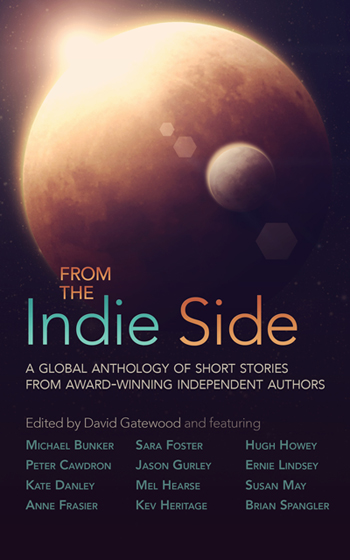
From the Indie Side is an fascinating milestone for the independent publishing movement. Why do I say that? Because if you want proof that Indie authors can write concise, beautifully turned out prose, then look no further than this collection of stories.
With some of the most talented new voices on the Indie scene, this anthology has the raw, electric energy of an underground movement. The stories span a multitude of genres; science fiction, fantasy, dystopian and paranormal. Many of the stories have a dark slant, many take place in dying or post apocalyptic worlds.
There’s excitement here. Meet the new paradigm; hard working craftspeople honing their writing and taking on the jobs traditionally left to publishers. Some of the stories in this collection are more polished than others, but all are well written, inventive and at times, even captivating. These writers are passionate about story as evidenced by the short commentary each author provides. It’s clear that obstacles, the paradigm shift in publishing or even a zombie apocalypse couldn’t stop these writers from their chosen rounds.
And I hope publishers and agents take notice, because allowing dedicated writers like these to slip through the net seems like a crime.
The editor, David Gatewood has a nose for talent and the anthology includes a range of material, nicely juxtaposed and often surprising. It’s a nice book, with clean prose and a modern bite.
Some of the writers stand out; Hugh Howey has a meticulous ear for dialogue and the ability to create an instant rapport with the plight of his characters. He’s a world builder who effortlessly draws you into a fully realized alternate reality. Michael Bunker has a gift for gritty realism and often surprises with his character’s quirky internal dialogue and his way of framing stories with a sense of encroaching dread. Anne Frasier creates a delicate, dreamlike, layering of experiences to weave a lyrical spell.
Sexism is notably absent and I was impressed by the fearlessness and range of the stories. Susan May takes a turn exploring the gruesome psychological effects of War while Kev Heritage takes on High Fantasy and tech magic. There’s a Twilight Zone-esque turn by Jason Gurley and Brian Spangler offers well-paced, unrelenting horror. Sara Foster offers a tricky surprise and Kate Danley, a malignant fairy tale. Ernie Lindsey imagines a society with a devastating ritual, Mel Hearse adds a dark twist and Peter Cawdron takes on a futuristic terrorism.
You will be catching some of these writers at an early stage in their journey. A few of them get caught up in the blow by blow action rather than the deeper currents of tension between the characters that drive a story forward. I would recommend a couple of these writers read Raymond Chandler’s thumbnail descriptions when establishing characters. But these are trivial points. What is important about the writers in From the Indie Side, is their sense of experimentation and absolute passion for writing. Highly recommended.
From the Indie Side is an fascinating milestone for the independent publishing movement. Why do I say that? Because if you want proof that Indie authors can write concise, beautifully turned out prose, then look no further than this collection of stories.
With some of the most talented new voices on the Indie scene, this anthology has the raw, electric energy of an underground movement. The stories span a multitude of genres; science fiction, fantasy, dystopian and paranormal. Many of the stories have a dark slant, many take place in dying or post apocalyptic worlds.
There’s excitement here. Meet the new paradigm; hard working craftspeople honing their writing and taking on the jobs traditionally left to publishers. Some of the stories in this collection are more polished than others, but all are well written, inventive and at times, even captivating. These writers are passionate about story as evidenced by the short commentary each author provides. It’s clear that obstacles, the paradigm shift in publishing or even a zombie apocalypse couldn’t stop these writers from their chosen rounds.
And I hope publishers and agents take notice, because allowing dedicated writers like these to slip through the net seems like a crime.
The editor, David Gatewood has a nose for talent and the anthology includes a range of material, nicely juxtaposed and often surprising. It’s a nice book, with clean prose and a modern bite.
Some of the writers stand out; Hugh Howey has a meticulous ear for dialogue and the ability to create an instant rapport with the plight of his characters. He’s a world builder who effortlessly draws you into a fully realized alternate reality. Michael Bunker has a gift for gritty realism and often surprises with his character’s quirky internal dialogue and his way of framing stories with a sense of encroaching dread. Anne Frasier creates a delicate, dreamlike, layering of experiences to weave a lyrical spell.
Sexism is notably absent and I was impressed by the fearlessness and range of the stories. Susan May takes a turn exploring the gruesome psychological effects of War while Kev Heritage takes on High Fantasy and tech magic. There’s a Twilight Zone-esque turn by Jason Gurley and Brian Spangler offers well-paced, unrelenting horror. Sara Foster offers a tricky surprise and Kate Danley, a malignant fairy tale. Ernie Lindsey imagines a society with a devastating ritual, Mel Hearse adds a dark twist and Peter Cawdron takes on a futuristic terrorism.
You will be catching some of these writers at an early stage in their journey. A few of them get caught up in the blow by blow action rather than the deeper currents of tension between the characters that drive a story forward. I would recommend a couple of these writers read Raymond Chandler’s thumbnail descriptions when establishing characters. But these are trivial points. What is important about the writers in From the Indie Side, is their sense of experimentation and absolute passion for writing. Highly recommended.
“Whatever distinctly human qualities war calls upon—honor, courage, solidarity, cruelty, and so forth—it might be useful to stop thinking of war in exclusively human terms. After all, certain species of ants wage war and computers can simulate “wars” that play themselves out on-screen without any human involvement. More generally, then, we should define war as a self-replicating pattern of activity that may or may not require human participation— Barbara Ehrenreich
I was watching TV pundit/editor of Mother Jones Magazine David Korn commenting on Bush/Cheney/Rumsfeld’s botched Iraq war when he said, “…it’s almost like saying if we had an army of a million giant flying robots things would have turned out better. It’s denying reality… it’s all a giant experiment for them…” Those two ideas struck me; irresponsible, inexperienced leadership and a million robot army. A scary proposition, fast becoming a very real possibility.
DARPA is slowly crafting robots around the art of war. What is DARPA? The Defense Advanced Research Projects Agency . DARPA funds an array of inventors and Scientists for the US government, developing high-tech weapons and machines such as drones. Some of the best robots under development are being created by Boston Dynamics who just unveiled The Atlas, a new humanoid robot. They also developed the Cheetah which holds the land speed record for robots and the Big Dog pack robot.
These robots may seem crude and awkward as they move through tunnels, trek up mountains, throw bricks, climb steps and fly in formation, but they represent the adaptation of technology to a disturbing purpose, navigating war zones, delivering payloads, entering enclosed structures and zapping the earth from the safety of the clouds.
Should we call a moratorium on the creation of lethal autonomous robotics? Christof Heyns, the UN special rapporteur on extrajudicial, summary or arbitrary executions, thinks so when he suggests, “Machines lack morality and mortality, and as a result should not have life and death powers over humans.”
Then there is Asimov’s Three Laws of Robotics.
A robot may not injure a human being or, through inaction, allow a human being to come to harm.
A robot must obey the orders given to it by human beings, except where such orders would conflict with the First Law.
A robot must protect its own existence as long as such protection does not conflict with the First or Second Law.
But could Asimov’s law be enforced? How can we stop a robot from being hacked or reprogrammed? And what about robots who learn, the classic SkyNet scenario from the Terminator movies where artificial intelligence develops its own agenda? Whether used creatively or destructively, Robot technology will no doubt be a perfect reflection of our own dreams and nightmares.
If you’ve never read David Mamet’s memo to the writers of The Unit, prepare to be amused.
The author of 50 plays and 25 screenplays, Mamet is a study in why playwrights often dazzle when it comes to screenwriting. They learn to move the plot forward dramatically, scene by scene, through character and dialogue, without the help of Lizard men descending from the ceiling or massive car chases.
Known for his witty, acerbic style, staccato musicality of dialogue and ability to render the dynamics of complex human emotion into nuanced, yet dramatic turns, Mamet’s writing is sometimes surprising and often lovely. His dialogue is so distinctive, it spawned the slang phrase Mamet Speak.
But in 2006, Mamet was working in the Hollywood Dream factory at the breakneck pace television demands, as executive producer on a weekly drama for Fox called The Unit, based on his co-producer’s book Inside Delta Force: The Story of America’s Elite Counter terrorist Unit. The show ran for four seasons.
In this letter, David Mamet’s frustration with his writer’s is apparent, but between the lines his love for them, the written word and the process of writing is clear. Enjoy!
TO THE WRITERS OF THE UNIT
GREETINGS.
AS WE LEARN HOW TO WRITE THIS SHOW, A RECURRING PROBLEM BECOMES CLEAR.
THE PROBLEM IS THIS: TO DIFFERENTIATE BETWEEN *DRAMA* AND NON-DRAMA. LET ME BREAK-IT-DOWN-NOW.
EVERYONE IN CREATION IS SCREAMING AT US TO MAKE THE SHOW CLEAR. WE ARE TASKED WITH, IT SEEMS, CRAMMING A SHITLOAD OF *INFORMATION* INTO A LITTLE BIT OF TIME.
OUR FRIENDS. THE PENGUINS, THINK THAT WE, THEREFORE, ARE EMPLOYED TO COMMUNICATE *INFORMATION* — AND, SO, AT TIMES, IT SEEMS TO US.
BUT NOTE:THE AUDIENCE WILL NOT TUNE IN TO WATCH INFORMATION. YOU WOULDN’T, I WOULDN’T. NO ONE WOULD OR WILL. THE AUDIENCE WILL ONLY TUNE IN AND STAY TUNED TO WATCH DRAMA.
QUESTION:WHAT IS DRAMA? DRAMA, AGAIN, IS THE QUEST OF THE HERO TO OVERCOME THOSE THINGS WHICH PREVENT HIM FROM ACHIEVING A SPECIFIC, *ACUTE* GOAL.
SO: WE, THE WRITERS, MUST ASK OURSELVES *OF EVERY SCENE* THESE THREE QUESTIONS.
1) WHO WANTS WHAT? 2) WHAT HAPPENS IF HER DON’T GET IT? 3) WHY NOW?
THE ANSWERS TO THESE QUESTIONS ARE LITMUS PAPER. APPLY THEM, AND THEIR ANSWER WILL TELL YOU IF THE SCENE IS DRAMATIC OR NOT.
IF THE SCENE IS NOT DRAMATICALLY WRITTEN, IT WILL NOT BE DRAMATICALLY ACTED.
THERE IS NO MAGIC FAIRY DUST WHICH WILL MAKE A BORING, USELESS, REDUNDANT, OR MERELY INFORMATIVE SCENE AFTER IT LEAVES YOUR TYPEWRITER. *YOU* THE WRITERS, ARE IN CHARGE OF MAKING SURE *EVERY* SCENE IS DRAMATIC.
THIS MEANS ALL THE “LITTLE” EXPOSITIONAL SCENES OF TWO PEOPLE TALKING ABOUT A THIRD. THIS BUSHWAH (AND WE ALL TEND TO WRITE IT ON THE FIRST DRAFT) IS LESS THAN USELESS, SHOULD IT FINALLY, GOD FORBID, GET FILMED.
IF THE SCENE BORES YOU WHEN YOU READ IT, REST ASSURED IT *WILL* BORE THE ACTORS, AND WILL, THEN, BORE THE AUDIENCE, AND WE’RE ALL GOING TO BE BACK IN THE BREADLINE.
SOMEONE HAS TO MAKE THE SCENE DRAMATIC. IT IS NOT THE ACTORS JOB (THE ACTORS JOB IS TO BE TRUTHFUL). IT IS NOT THE DIRECTORS JOB. HIS OR HER JOB IS TO FILM IT STRAIGHTFORWARDLY AND REMIND THE ACTORS TO TALK FAST. IT IS *YOUR* JOB.
EVERY SCENE MUST BE DRAMATIC. THAT MEANS: THE MAIN CHARACTER MUST HAVE A SIMPLE, STRAIGHTFORWARD, PRESSING NEED WHICH IMPELS HIM OR HER TO SHOW UP IN THE SCENE.
THIS NEED IS WHY THEY *CAME*. IT IS WHAT THE SCENE IS ABOUT. THEIR ATTEMPT TO GET THIS NEED MET *WILL* LEAD, AT THE END OF THE SCENE,TO *FAILURE* – THIS IS HOW THE SCENE IS *OVER*. IT, THIS FAILURE, WILL, THEN, OF NECESSITY, PROPEL US INTO THE *NEXT* SCENE.
ALL THESE ATTEMPTS, TAKEN TOGETHER, WILL, OVER THE COURSE OF THE EPISODE, CONSTITUTE THE *PLOT*.
ANY SCENE, THUS, WHICH DOES NOT BOTH ADVANCE THE PLOT, AND STANDALONE (THAT IS, DRAMATICALLY, BY ITSELF, ON ITS OWN MERITS) IS EITHER SUPERFLUOUS, OR INCORRECTLY WRITTEN.
YES BUT YES BUT YES BUT, YOU SAY: WHAT ABOUT THE NECESSITY OF WRITING IN ALL THAT “INFORMATION?”
AND I RESPOND “*FIGURE IT OUT*” ANY DICKHEAD WITH A BLUESUIT CAN BE (AND IS) TAUGHT TO SAY “MAKE IT CLEARER”, AND “I WANT TO KNOW MORE *ABOUT* HIM”.
WHEN YOU’VE MADE IT SO CLEAR THAT EVEN THIS BLUESUITED PENGUIN IS HAPPY, BOTH YOU AND HE OR SHE *WILL* BE OUT OF A JOB.
THE JOB OF THE DRAMATIST IS TO MAKE THE AUDIENCE WONDER WHAT HAPPENS NEXT. *NOT* TO EXPLAIN TO THEM WHAT JUST HAPPENED, OR TO*SUGGEST* TO THEM WHAT HAPPENS NEXT.
ANY DICKHEAD, AS ABOVE, CAN WRITE, “BUT, JIM, IF WE DON’T ASSASSINATE THE PRIME MINISTER IN THE NEXT SCENE, ALL EUROPE WILL BE ENGULFED IN FLAME”
WE ARE NOT GETTING PAID TO *REALIZE* THAT THE AUDIENCE NEEDS THIS INFORMATION TO UNDERSTAND THE NEXT SCENE, BUT TO FIGURE OUT HOW TO WRITE THE SCENE BEFORE US SUCH THAT THE AUDIENCE WILL BE INTERESTED IN WHAT HAPPENS NEXT.
YES BUT, YES BUT YES *BUT* YOU REITERATE.
AND I RESPOND *FIGURE IT OUT*.
*HOW* DOES ONE STRIKE THE BALANCE BETWEEN WITHHOLDING AND VOUCHSAFING INFORMATION? *THAT* IS THE ESSENTIAL TASK OF THE DRAMATIST. AND THE ABILITY TO *DO* THAT IS WHAT SEPARATES YOU FROM THE LESSER SPECIES IN THEIR BLUE SUITS.
FIGURE IT OUT.
START, EVERY TIME, WITH THIS INVIOLABLE RULE: THE *SCENE MUST BE DRAMATIC*. it must start because the hero HAS A PROBLEM, AND IT MUST CULMINATE WITH THE HERO FINDING HIM OR HERSELF EITHER THWARTED OR EDUCATED THAT ANOTHER WAY EXISTS.
LOOK AT YOUR LOG LINES. ANY LOGLINE READING “BOB AND SUE DISCUSS…” IS NOT DESCRIBING A DRAMATIC SCENE.
PLEASE NOTE THAT OUR OUTLINES ARE, GENERALLY, SPECTACULAR. THE DRAMA FLOWS OUT BETWEEN THE OUTLINE AND THE FIRST DRAFT.
THINK LIKE A FILMMAKER RATHER THAN A FUNCTIONARY, BECAUSE, IN TRUTH, *YOU* ARE MAKING THE FILM. WHAT YOU WRITE, THEY WILL SHOOT.
HERE ARE THE DANGER SIGNALS. ANY TIME TWO CHARACTERS ARE TALKING ABOUT A THIRD, THE SCENE IS A CROCK OF SHIT.
ANY TIME ANY CHARACTER IS SAYING TO ANOTHER “AS YOU KNOW”, THAT IS, TELLING ANOTHER CHARACTER WHAT YOU, THE WRITER, NEED THE AUDIENCE TO KNOW, THE SCENE IS A CROCK OF SHIT.
DO *NOT* WRITE A CROCK OF SHIT. WRITE A RIPPING THREE, FOUR, SEVEN MINUTE SCENE WHICH MOVES THE STORY ALONG, AND YOU CAN, VERY SOON, BUY A HOUSE IN BEL AIR *AND* HIRE SOMEONE TO LIVE THERE FOR YOU.
REMEMBER YOU ARE WRITING FOR A VISUAL MEDIUM. *MOST* TELEVISION WRITING, OURS INCLUDED, SOUNDS LIKE *RADIO*. THE *CAMERA* CAN DO THE EXPLAINING FOR YOU. *LET* IT. WHAT ARE THE CHARACTERS *DOING* -*LITERALLY*. WHAT ARE THEY HANDLING, WHAT ARE THEY READING. WHAT ARE THEY WATCHING ON TELEVISION, WHAT ARE THEY *SEEING*.
IF YOU PRETEND THE CHARACTERS CANT SPEAK, AND WRITE A SILENT MOVIE, YOU WILL BE WRITING GREAT DRAMA.
IF YOU DEPRIVE YOURSELF OF THE CRUTCH OF NARRATION, EXPOSITION,INDEED, OF *SPEECH*. YOU WILL BE FORGED TO WORK IN A NEW MEDIUM – TELLING THE STORY IN PICTURES (ALSO KNOWN AS SCREENWRITING)
THIS IS A NEW SKILL. NO ONE DOES IT NATURALLY. YOU CAN TRAIN YOURSELVES TO DO IT, BUT YOU NEED TO *START*.
I CLOSE WITH THE ONE THOUGHT: LOOK AT THE *SCENE* AND ASK YOURSELF “IS IT DRAMATIC? IS IT *ESSENTIAL*? DOES IT ADVANCE THE PLOT?
ANSWER TRUTHFULLY.
IF THE ANSWER IS “NO” WRITE IT AGAIN OR THROW IT OUT. IF YOU’VE GOT ANY QUESTIONS, CALL ME UP.
LOVE, DAVE MAMET SANTA MONICA 19 OCTO 05
(IT IS *NOT* YOUR RESPONSIBILITY TO KNOW THE ANSWERS, BUT IT IS YOUR, AND MY, RESPONSIBILITY TO KNOW AND TO *ASK THE RIGHT Questions* OVER AND OVER. UNTIL IT BECOMES SECOND NATURE. I BELIEVE THEY ARE LISTED ABOVE.)
Below the thunders of the upper deep; Far, far beneath in the abysmal sea, His ancient, dreamless, uninvaded sleep The Kraken sleepeth: faintest sunlights flee About his shadowy sides: above him swell Huge sponges of millennial growth and height; And far away into the sickly light, From many a wondrous grot and secret cell Unnumbered and enormous polypi Winnow with giant arms the slumbering green. There hath he lain for ages and will lie Battening upon huge sea-worms in his sleep, Until the latter fire shall heat the deep; Then once by man and angels to be seen, In roaring he shall rise and on the surface die. — Alfred Lord Tennyson
Remember those spooky artists renderings of sperm whales battling Giant Squids? Or the 19th century illustrations of boats being pulled down into the depths by tentacled arms?
Well, it turns out, those stories were true.
Image from Discovery/NHK funded mission
A crew of Scientists, funded by Discovery channel and Japan’s NHK TV, just filmed a bus sized Giant Squid in its natural habitat for the first time. As a writer, this intersection of mythology and reality is particularly fascinating. Writers deal in myth and story and we rarely get to see a creature emerge from the crucible of legend into cold, hard reality.
For 3000 years, the giant squid was mythology; codified by sailors, deified as The Kraken, dramatized by Jules Verne in 20,000 leagues under the sea and sung into existence by Alfred Lord Tennyson. The slumbering giant moved with us through history, glimpsed in pieces, with no more substance than a dream. But now, recorded in digital perfection, the Giant Squid, Architeutis dux, is visible and unquestionably real. “Then once by men and angels to be seen,” Tennyson wrote. And now we can see the creature for ourselves, not red and decomposing, rising to the surface in its death throes, but vibrant and alive, clothed in silvery beauty and otherworldly strangeness, tentacles snaking out beneath the ocean’s surface— Lovecraft’s Cthuthu come to life.
Of course, people have seen this creature all along. The Giant Squid was recorded by Homer’s Odyssey as the Scylla, in Viking legends as The Kraken and was sighted by Aristotle and Pliny the Elder. The threads of the legends came from real encounters. This fact alone should make us wonder what other mythological creatures in this world are true. With the rise of Zoology in the 18th and 19th century, evidence began to mount about the reality of the Giant Squid’s existence: Squid Sightings
With the advent of movable type and newspapers, Squid sightings were being reported by sailors. Beached squids were measured, beaks, tails and tentacles were preserved in alcohol or honey and sent to scientific societies around the world. By the 19th century, a few European Zoologists speculated the creature might actually exist. Still, despite the evidence, there was enormous resistance in the Scientific community. In 1857, Japetus Steenstrup, a Danish zoologist at the University of Copenhagen, postulated the Squid was real, based on a beak and past sightings, “From all evidences the stranded animal must thus belong not only to the large, but to the really gigantic cephalopods, whose existence has on the whole been doubted.”
Japetus Steenstrup named the creature: Architeutis dux.
Giant Squid Sightings
In 350 B.C. Greek philosopher Aristotle first described greater and the lesser squid. He called the great squid teuthos. “The Teuthos is much larger than the Teuthis, for it reaches the length of five cubits. Some species are two cubits long, and the tentacula of the polypus are as long and even larger in size. The class of Teuthos is rare and differs in form from Teuthis, for the extremity of the Teuthos is wider; and again the fin is placed round the whole abdomen, but it is wanting in the Teuthis. ” So Aristotle had seen a Squid the size of a man or longer.
Pliny the Elder, living in the first century A.D. described a gigantic squid in his Natural History, with the head “as big as a cask”, arms 30 feet (9.1 m) long, and carcass weighing 700 pounds (320 kg).
With the onset of the Industrial age and steam ships, Giant Squid sightings changed in tone. Instead of being beached or washed ashore, men not only encountered the animal on the seas, they were no longer subject to the capricious winds.
Illustration of the Alecton’s encounter with a Colossal Squid.
In 1861, the French dispatch steamer Alecton, sighted a “sea-monster” off the Canary Islands. They pursued, harpooned and shot the animal then tied it with ropes and tried to haul it on deck. When the ropes sliced the monster in half, they managed to acquire the tail. (From the artists rendering of their eye-witness account, the monster was probably a Colossal Squid: Mesonychoteuthis hamiltoni.) The Commander of the Alecton contacted the French consul and filed an account with the French Academy of Sciences, showing the spear-shaped tail as proof. A member of that august body, Arthur Mangin, summed up the Scientific response, saying no “wise” person, “especially a man of science,” would “admit into the catalogue those stories which mention extraordinary creatures like the sea serpent or the giant squid, the existence of which would be…. a contradiction of the great laws of harmony and equilibrium which have sovereign rule over living nature as well as senseless and inert matter.”
Baroque Pauline Squid Sighting
On January 8th, 1875, the Baroque Pauline sighted a Sperm Whale battling a “Monster Sea Serpent.” The crewman carefully described what he observed, making a rendering of the whale’s battle with the serpent.
“The weather fine and clear, the wind and sea moderate. Observed some black spots on the water, and a whitish pillar, about thirty-five feet high, above them At the first glance I took all to be breakers, as the sea was splashing up fountain-like about them, and the pillar, a pinnacle rock bleached with the sun; but the pillar fell with a splash, and a similar one rose. They rose and fell alternately in quick succession, and good glasses showed me it was a monster sea-serpent coiled twice round a large sperm whale. “
Size Matters
During World War II, a British Admiralty trawler was lying off the Maldives Islands in the Indian Ocean. One of the crew, A.G. Starkey, was on deck late at night when he saw something peculiar in the water. “As I gazed, fascinated, a circle of green light glowed in my area of illumination. This green unwinking orb I suddenly realized was an eye. The surface of the water undulated with some strange disturbance. Gradually I realized that I was gazing at almost point-blank range at a huge squid.’ Starkey walked the length of the ship finding the tail at one end and the tentacles at the other. The ship was over one hundred and seventy five feet long.”
On November 2nd, 1878 a Giant Squid was beached at Thimble Thickle Bay, Newfoundland. The dying squid measured 20 feet in length from tip of the head to bottom of the beak. The longest tentacles were 35 feet, making the creature 55 feet in length.
Giant Squid Attacks
The most remarkable account of a Giant Squid attack took place in 1874 in the Bay of Bengal and was reported by a number of Indian newspapers and the London Times ( a few years before Jules Verne’s 20,000 Leagues under the sea was published). The attack was also witnessed by a passing steam ship, the Strathowen.
Illustration from 1st edition of Jules Verne’s 20,000 Leagues under the Sea, based on the Giant Squid attack on the Schooner Pearl
In 1874, three days out of Galle, the 150 ft long Schooner Pearl was attacked by a Giant Squid. A second ship, the steamer Strathowen, watched the Pearl go down. One passenger who witnessed the sinking testified,“As I watched, the mass was set in motion. It struck the schooner, which visibly reeled, and then righted. Immediately afterwards, the masts swayed sideways, and I could clearly discern the enormous mass and the hull of the schooner coalescing – I can think of no other term. Almost immediately after the collision and coalescence the schooner’s masts swayed towards us, lower and lower; the vessel was on her beam-ends, lay there for a few seconds, and disappeared, the masts righting as she sank, and the main exhibiting a reversed ensign struggling towards its peak.”
Captain James Floyd describes the attack, “a great mass rose slowly out of the sea about half-a-mile off on our larboard side, and remained spread out, as it were, and stationary; it looked like the back of a huge whale, but it sloped less, and was of a brownish colour; even at that distance it looked longer than our craft, and it seemed to be basking in the sun.”
“‘What’s that?’ I sung out to the mate. ‘Blest if I knows; barring its size, colour, and shape, it might be a whale,’ replied Tom Scott; ‘and it ain’t the serpent,’ said one of the crew, ‘for he’s too round for that ‘ere critter.’”
Crew member Bill Darling recognized the shape in the water closing in on the Pearl. Many historical sightings had taken place in his native land of Newfoundland. Darling identified the animal as a Giant Squid, warning the Captain not to fire on the creature. But Captain Floyd chose to ignore the warning and shot at the advancing Squid.
Floyd gave the following account, “By this time three of the crew, Bill included, had found axes, and one a rusty cutlass, and all were looking over the ship’s side at the advancing monster. We could now see a huge oblong mass moving by jerks just under the surface of the water, and an enormous train following; the wake or train might have been 100 feet long.
“In the time I have taken to write this the brute struck us, and the ship quivered under the thud; in another movement, monstrous arms like trees seized the vessel and she keeled over; in another second the monster was aboard, squeezed in between the two masts, Bill screaming ‘slash for your lives.’ But all our slashing was to no avail, for the brute, holding on by his arms, slipped his vast body overboard, and pulled the vessel down with him; we were thrown into the water at once, and just as I went over, I caught sight of one of the crew, either Bill or Tom Fielding, squashed up between the masts and one of those awful arms.”
Only four members of the crew and Captain Floyd survived.
This astounding attack influenced writer’s Jules Verne, Peter Benchley who wrote Jaws and Beast and Arthur C. Clarke who wrote a paper on the subject titled Reflections on Squid.
Giant Squid and Sperm Whale, the squid’s natural predator.
In the 1930′s, The Brunswick, a royal Norwegian Navy ship reported being attacked by Giant Squid at least three times. The Giant Squid pulled along side of the ship, pacing it with their jet propulsion, then suddenly rammed into the ship and wrapped its tentacles around the hull. Unable to keep a grip on the steel hull, the animal slid off and fell into the ship’s propellers.
During World War II (in 1941), survivors of the troopship Britannia sunk by a German raider The Thor, clung to the sides of the life rafts. Survivor Lieutenant R. E. G. Cox, told author of The Kingdom of the Octopus, Frank Lane, that on the first night a man was plucked from the raft by a large squid. Later that same night, Cox himself was attacked. A tentacle wrapped around his leg, then released him leaving painful scars.
In January 2003, French veteran yachtsman Oliver de Kersauson’s ship was attacked by a giant squid while ironically competing for the Jules Verne trophy. “I saw a tentacle through a porthole. It was thicker than my leg and it was really pulling the boat hard.” The squid released the boat once the motor stopped. “We didn’t have anything to scare off this beast, so I don’t know what we would have done if it hadn’t let go. We weren’t going to attack it with our penknives,” he said. Kersauson says the squid must have been 22 to 26 feet (7 to 8 meters) long. “I’ve never seen anything like it in 40 years of sailing,” Kersauson said.
(Don’t ask me what Giant Squid have against the French…)
The Giant Squid or Architeutis dux is the largest of all invertebrates, reaching lengths of 60 feet (18 meters) and possibly, if the WW2 witness is correct, 200 ft in length.